Day 28. 8th September: Our Food Tour Begins, and Ends With a Dive Underground
Today we have a food tour through Airbnb Experience, “Street food tour with a local,” which kicks off at 10:30 AM. We made our way to the meeting point, about 700 meters from where we’re staying, which happens to be the statue of Diana and met up with another 14 people.
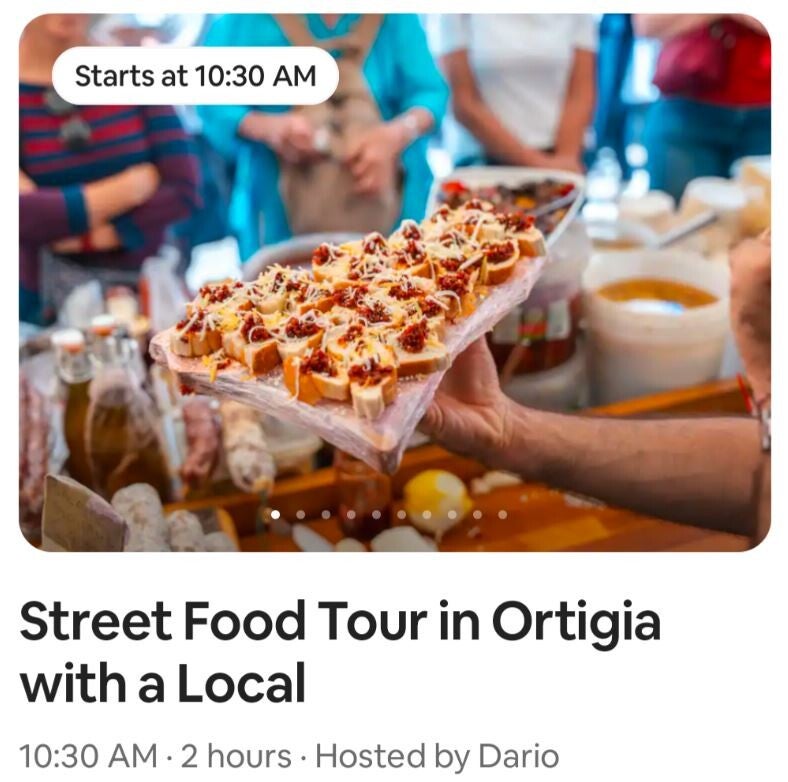
Street Food Tour in Ortigia with a Local - Dario from Ortigia, Sicily
They were a mix of people: some girls from Hong Kong here for one of their birthdays, six people from the USA who were there for one of the couple’s sons getting married in Taormina next week, another USA couple who just came over for a week, and another young fellow who had just finished working in Strasbourg for a couple of years and was now doing a bit of traveling before he heads back to the States for work. They were all a pretty good bunch.
Our guide was Dario. He works online between the hours of 3 PM and 12 AM for a finance firm in Brazil and then does food tours Monday to Friday in the shoulder and off-peak seasons here in Ortigia. He and his wife then take three months off for holidays in the peak season and travel somewhere different in the world. Hard life, I tell you!

The famous “Arancini al Ragu”

Granita al caffe
Our first stop was to taste the granita al caffè at Gelateria Gusto, which is espresso coffee with a ever-slight-taste of pistachio mixed with fine ice—like a slushy but creamier. They really are great. We had them in Italy somewhere last year and they taste like a tiramisu on steroids and are just what’s needed in this warm weather. Everyone thoroughly enjoyed them.
The next stop was for the famous “Lucia's Arancini al ragù.” at a small eatery called Antica Giudecca For it to be a proper ragù, the meat must be cooked for a minimum of five hours before it’s combined with risotto rice, saffron, mozzarella, and ricotta cheese with a few secret herbs and bread crumbs. This little bakery/eatery is very well known in Ortigia. The line-up can be long, but being on a food tour they opened up half an hour earlier for us. We all got half a ball each, as they were quite large, and they were absolutely delicious. It’s put any other arancini ball you have ever tasted to shame. Other eateries selling arancini balls in Sicily are all selling the same, bought from the same wholesalers, so don't even bother as they taste so bland!
As we moved on, he spoke a lot about his hidden Ortigia and the history of the area, along with the local Sicilian people and their passion for fresh seafood and vegetables. He talked about how there are nineteen churches and only two priests. He walked us through the Jewish Quarter and explained the history. This was a stroll around his town, and behind every hidden corner there was something new to learn.

Daily market fresh herbs and spices
Ortigia Markets: This is a Market, Not Like Palermo!
Our next stop was the daily markets, open every day of the week except Sundays. These markets consist of fresh seafood and vegetables, spices like you would expect to see in Morocco or the Middle East, fresh sardines and octopus being cooked, side-stall cafes, and trinket stalls. It had everything and it was full-on, with fish vendors yelling out their best prices on their fresh swordfish and tuna, and the local vegetable man trying to raise his voice above them. It’s just what you expect to see.
Dario spoke about the fishing season, when to buy fish, and what type during what months. He explained where the fresh fruit and vegetables come from and what not to buy—such as bananas from Brazil—and warned that any oysters you see are not from here, even if they are labelled so.
We stopped at a couple of stalls and tried these sun-dried tomatoes with almond and pistachio, which somehow still held their texture but were all incorporated. This was served on small slices of fresh bread with Parmesan shaved over the top. It was divine. We also tried ricotta cheese infused with possibly a bacon flavour—I wasn’t 100% sure—and a slice of salami. The taste buds were certainly getting a workout today.

Tasting Platters being handed around

Freshly caught seafood

Freshly made Granitas for everyone
As these dishes were served up, he went into how they are made, where they come from, and how they should be eaten. He was very knowledgeable and took great pride in what he was telling us.
Next, we tried some prickly pear. I had heard of it but wasn’t sure what it was. He explained it’s the fruit of the cactus and they are produced every two years. Meanwhile, I looked over my shoulder and saw some sitting in a box, so I picked one up to have a play with it—all while he was explaining to the others, “You should never pick these up in your hands, as you will have tiny little spikes in your fingers for the rest of your trip.” Um, a bit late Dario, I dropped it back in the box, and sure enough, I could feel the tiniest little spikes in three of my fingers which then took forever to get out. I was not impressed!
We all got to taste a different prickly pear, as each colour had its own unique flavour. They weren’t too bad, but they would have been better cold. My orange one tasted like kiwi fruit, and Leanne’s green was like honeydew melon. I would definitely order them if they were on a menu for dessert with some ice cream.
We also tried this pistachio paste, which is what they use instead of Nutella. This I could go for anytime. It was finely whipped, and you just spread it on bread or whatever you feel like. I really should have grabbed a jar.

Fresh Paninis being made

Yummy Gelato

Fried up Sardines
It was time to eat again, and Dario always rings ahead to let them know he has a group arriving, so it’s what you call “skip the line.” And I’m glad he did, because this next place is world-famous and has many YouTube videos showing why it’s so popular. The line-up was at least thirty people deep, but he waved us through, and we had one of the guys ready to make us all panini.
The place is called “Caseificio Borderi,” famous for their paninis, pickled onions, tomato paste which they export worldwide. I took a video of them making the panini, and it’s pretty impressive—it goes for six minutes!
Once the panini were made, we all sat under some trees and devoured them. I’ve had panini before, but these were the best ever. The video explains what actually goes in them, and now that I know how they're made—I'll still never be able to make one.
At the end of the tour, we all had granitas at another famous little ice creamery. It was a blend of oranges and mandarins with some mint. This was just what we needed, as the temperature was now in the low thirties.
We had been on a food tour years ago in Spain, but this one exceeded it and was worth every dollar. He was brilliant and a very nice guy. Along with a great tour group, it was a wonderful day and exceeded my expectations. The tour said two hours, but it ended up being three in the end.
I highly recommend Dario’s walking food tour if you are ever in Syracuse, but he only runs it in the shoulder and off-peak season as it’s too hot in July and August.

Our Foodie's Group With Dario our Guide
Descending into History: The Jewish Baths of Ortigia
During the tour, he took us to an old church—the only old Jewish site that still has tunnels running underneath Ortigia. These tunnels link every other church and even reach the fort out on the point; they are located 18 meters underground. They were started back in the Roman days around 6 AD and are still there today.
Apparently, the Romans rounded up many Jews from Jerusalem and brought them over here as slaves, but there is evidence that the Jewish people were here well before that and the population was about 25% Jewish. Anyway, the Romans said, “Convert to Catholicism or die.” So most converted, but they filled in the entrances to these tunnels that ran below Ortigia to preserve their holy place and the sacred baths from destruction. They are called “The Jewish Baths of Ortigia,” original Jewish ritual baths from 6 AD.
Leanne and I decided to catch the 3:30 tour and go down to have a look. The first level is where they prepared the bodies—disembowelled and cleaned them up. The second level consisted of old 15th-century steps that are pretty steep, leading into a small chamber which the Romans built and hadn’t been touched since. I couldn’t quite make out what he said it was, as he had a very thick Italian accent but it was used in the Second World War as an operating theatre.
And the third level down is where the baths are, which were for women to bathe in at certain times of the month. It is pretty impressive how people back in those times figured out how to get light down here from 18m above.

Church of Saint Philip the Apostle (Crypt)

Stairs Leading down towards the Baths

Ancient Tunnels below Ortigia

Final Steps to The Bath

Jewish ritual baths, known as a Mikveh

Natural Light From Above Filters Down
The Jewish Baths took on a whole new life during the Second World War, housing over 10,000 people deep underground to keep them safe. Even in hot months of summer, the temperature down there stayed at a steady 27 degrees, which explains why they even set up a fully functioning operating theatre in the tunnels to cater to that many people
What I love about European history is that you can actually see it, touch it, and feel it for yourself. In Australia, everything would likely be behind glass or fences—but then again, we have way less history to begin with. (This can be argumentative)

Spaghetti with pine nuts, pistachio, breadcrumbs, tomatoes and sardines

Bruschetta

Cheers to our Final Night

Softly lit Streets in Ortigia

Toasting our Last Night in Ortigia

Cannolo - Pistachio and chocolate
We absolutely loved Ortigia. I can't say too much about Syracuse itself, as we never really ventured off the island. Coming from the Alps to the heat of Sicily and seeing how dry and sparse it actually was—with the hassles at the airport trying to organise a bus, the graffiti on the way into Syracuse, and the rip-off taxi driver—we weren't sure it would live up to the expectations we had read about.
But how wrong were we. With thousands of years of history crammed into a square kilometer, the stunning architecture, and the narrow streets along with some of the best views of the ocean, it's living history.
Create Your Own Website With Webador